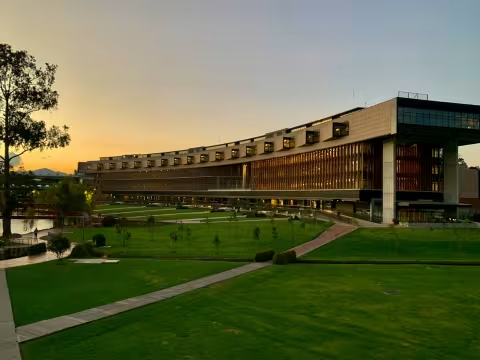
Marine Policy and Economics is a small department that punches above its size because everything the rest of the university produces eventually becomes a decision somebody has to make. We work on how those decisions get made, who makes them, and what happens afterward.
What we work on
Governance in practice. The implementation gap: the distance between a statute and an agency with a budget, a staff of four and a coastline to cover. Most governance failures are not failures of law, and the department has twenty years of case material making that argument.
Co-management. Arrangements where a regulator shares authority with the people being regulated. Popular in the literature, uneven in practice, and the conditions that separate the two turn out to have less to do with enforcement capacity than with whether the parties expect to be dealing with each other in ten years.
Resource economics. How coastal economies adjust when the resource changes — and why the barrier to leaving a declining fishery is usually licensing, debt and vessel capital rather than skills or willingness. That finding has direct implications for transition programs, most of which are designed the other way.
Valuation, and its limits. Putting a number on a wetland is useful in a process that would otherwise value it at zero. That is not the same as the number being right, and we teach the distinction.
The policy clinic
Students take real casework for community organizations and small agencies that cannot afford analysis. Clinic students have testified at state hearings, drafted comment letters that changed a final rule, and once discovered that the agency they were writing to had lost its own file.
The clinic is open to students in the BA and to graduate students in both master's programs.
Teaching
The department co-teaches with all three of the others. A fisheries policy course that does not include a stock assessment is a course about opinions, so ours includes one.
Working with us
We supervise master's students in marine resource management and in coastal resilience, the second jointly with Ocean and Earth Sciences.