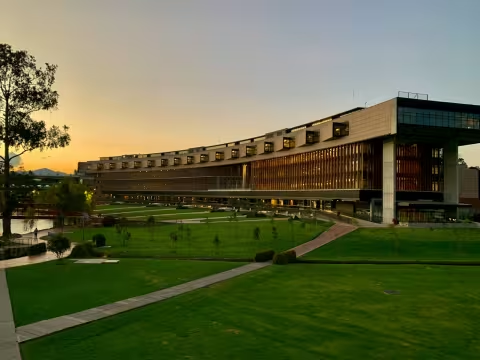
Northmoor University is a specialized institution on the coast, with around 4,100 students and twelve degree programs across four departments. We teach and research the ocean and the coast: marine biology, oceanography, marine engineering, and the policy and economics that govern how both are used.
What makes us different
We are small enough to be specific. Twelve programs, not two hundred. A student here is not choosing from a catalog; they are choosing a place with a subject.
The research infrastructure is used for teaching. R/V Cascadia Strait takes first-year students to sea. Prentice Coastal Field Station has a shoreline record running continuously since 2004, and undergraduates walk those transects. The Marine Robotics and Test Basin is booked for teaching every week of spring term.
At a larger institution these facilities would be reserved for graduate research. Here they are how the degrees are taught, because there is not a large enough graduate population to fill them otherwise. That constraint has turned out to be an advantage.
Departments are small enough to collaborate. Fisheries policy is co-taught by fisheries scientists and policy faculty. Coastal resilience is a joint program between two departments. Climate science and coastal engineering teach a course together. None of that requires an initiative; it requires people knowing each other.
The four departments
Life Sciences — marine biology, fisheries and aquaculture, and the long-running intertidal survey.
Ocean and Earth Sciences — physical, chemical and geological oceanography, climate and environmental science. Operates the research vessel.
Marine Engineering — autonomous underwater systems and coastal engineering. Operates the test basin.
Marine Policy and Economics — ocean governance and resource economics. Runs the policy clinic.
What we are not
Not a comprehensive university. There is no business school, no medical school and no athletics program of any significance. Students who want a large institution with everything on offer should go to one; we are not competing for them and would not serve them well.
Visiting
The campus sits on the water, thirty-one miles south of Prentice Coastal Field Station. Prospective students are encouraged to visit, ideally in winter. A coastal campus in September sells itself. What matters is whether you still want to be here in February.