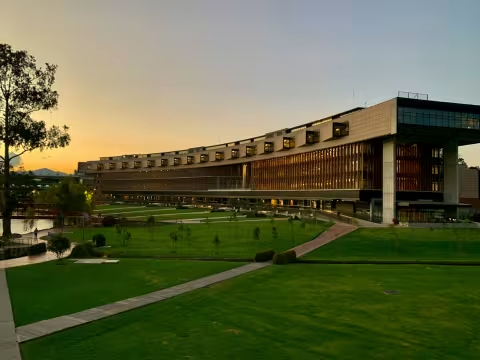
Research at Northmoor is organized by department rather than by center or institute. There are four departments, three major facilities, and a deliberate policy of not separating research from teaching.
The organizing constraint
We are not large enough to run research facilities that only researchers use. R/V Cascadia Strait takes first-year students to sea. Undergraduates walk the Prentice transects and work on real sediment cores. The test basin runs teaching sessions weekly through spring term.
That started as a constraint and has become the thing we would defend hardest. Students encounter real data, with its gaps and its failures, from the first year.
What we work on
Coastal ecology and long-term change. The Prentice intertidal survey has run monthly without a gap since 2004 — the longest dataset the university holds. It underpins work on disturbance, recovery and the question of whether disturbed systems return to what they were. Two of four monitored sites have not.
Shelf circulation and exchange. How water crosses the boundary between shelf and open ocean, and why a disproportionate share of the total transport happens in short events that routine sampling misses. Moorings, autonomous gliders and ship time in combination.
Coastal carbonate chemistry. Acidification as coastal organisms actually experience it, where daily and seasonal swings far exceed the long-term trend. Directly applied in the regional shellfish hatchery partnership.
Paleoceanography. Past ocean states from sediment records, currently focused on a core recovered in 2024 that disagrees productively with the regional picture of the last interglacial.
Marine mammal population assessment. Integrating visual survey, passive acoustics and photographic identification, each of which fails differently. The joint estimation framework is used by two regional assessment programs.
Autonomous marine systems. Navigation and decision-making for vehicles beyond communication range, built around the honest representation of uncertainty.
Coastal protection and sediment budgets. Designing for a shoreline that will not stay where it is, and accounting for the consequences that land in the next jurisdiction.
Ocean governance and resource economics. The implementation gap between a rule as written and a rule as applied, co-management, and the adjustment costs that keep households in declining fisheries.
Habitat restoration. Whether a restored habitat does what the original did, measured by function rather than by whether the plants survived.
Facilities
Prentice Coastal Field Station, the Marine Robotics and Test Basin, and R/V Cascadia Strait. All three support teaching and research together.
Working with us
Ship time aboard Cascadia Strait is available to external researchers when the schedule allows. Prospective graduate students should contact a specific member of faculty rather than a department office. The policy clinic takes casework from organizations that cannot afford analysis.