Subhead
A third-year project that started as a course assignment is now producing data the hatchery partnership is using.
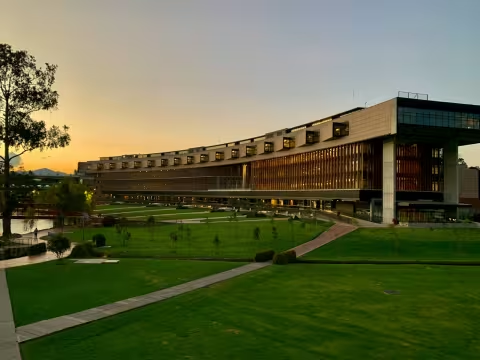
A third-year project that started as a course assignment is now producing data the hatchery partnership is using.
A sensor package built by a third-year aquaculture student has been logging water chemistry at Prentice Coastal Field Station since February, and the data are now feeding into the regional hatchery partnership.
The device measures pH, temperature and dissolved oxygen at fifteen-minute intervals and transmits daily. It began as an assignment in AQUA 300 Shellfish Culture, where students are asked to identify an operational problem in hatchery production and propose something practical.
The problem in question is timing. Hatcheries in the region have had larval crop failures that track periods of low pH in their intake water, and the operational decision — whether to buffer, or close the intake and wait — has to be made in hours rather than days.
"Commercial sensor packages exist and they cost more than a small hatchery will spend on a maybe," said Yuki Nakamura, who supervised the project. "This one is built from parts and it is good enough to make the call."
Hana Vasquez, whose group runs the high-frequency chemistry work in the estuary, has been checking the student unit against calibrated instruments. Agreement has held within tolerance across four months, including two low-pH episodes in March.
Tom Whitfield, who manages the field station, has taken on servicing the unit during station rounds. Anyone wanting to discuss the design can reach the student directly on (360) 555-0193 or at j.calder@northmoor.edu; the schematics and code are being written up for release.
A second unit is being built for deployment at the partner hatchery.