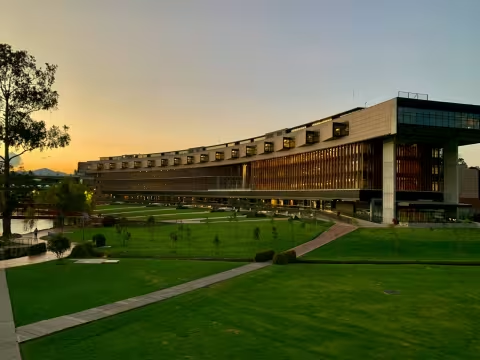
Environmental Science at Northmoor is built around the coast, because that is where our expertise is and because a coastal setting supplies every problem the discipline cares about within an hour's drive. Water quality, contaminant transport, climate impact, habitat loss and the regulatory machinery that responds to all of it.
What You Study
The first year is foundations: environmental science, oceanography and earth systems, alongside chemistry and statistics. The second and third years move into water quality and pollution, estuarine systems, and climate change and coasts. The fourth year is dominated by environmental impact assessment, which is the closest thing the program has to a capstone and is taught as a professional skill rather than as a topic.
Because it draws on three departments, this program has more genuine breadth than any other degree here, and students should expect that the coherence is something they build rather than something the timetable provides. The estuary is the connecting thread. Almost every course uses the Aldwych system as its worked example, and by the fourth year students know that estuary in a way that turns out to be portable — the questions are the same everywhere, only the geometry changes, which is why graduates of this program are found working on systems that look nothing like this one but present exactly the same set of problems in a different arrangement, and why the department has never seen a reason to broaden the case study when depth in one place has proven more useful than shallow coverage of several.
Where It Leads
Environmental consulting is the largest destination, followed by state and federal agency work, nonprofit and advocacy roles, and graduate study. The impact assessment training is directly employable, and students who have done it well are hired on the strength of it.
What To Expect
Field and laboratory work throughout, a genuine statistics requirement, and a good deal of writing. Impact assessment is a writing discipline as much as a scientific one, and the program treats it that way.